Polling News

Gallup’s Final Presidential Approval Tracking

February 19, 2026

Gallup announced that it will stop measuring presidential approval rating after almost 90 years of tracking. This news comes as President Donald Trump’s average approval rating hits the lowest point for any president since Gallup began polling on this question in the 1930s.
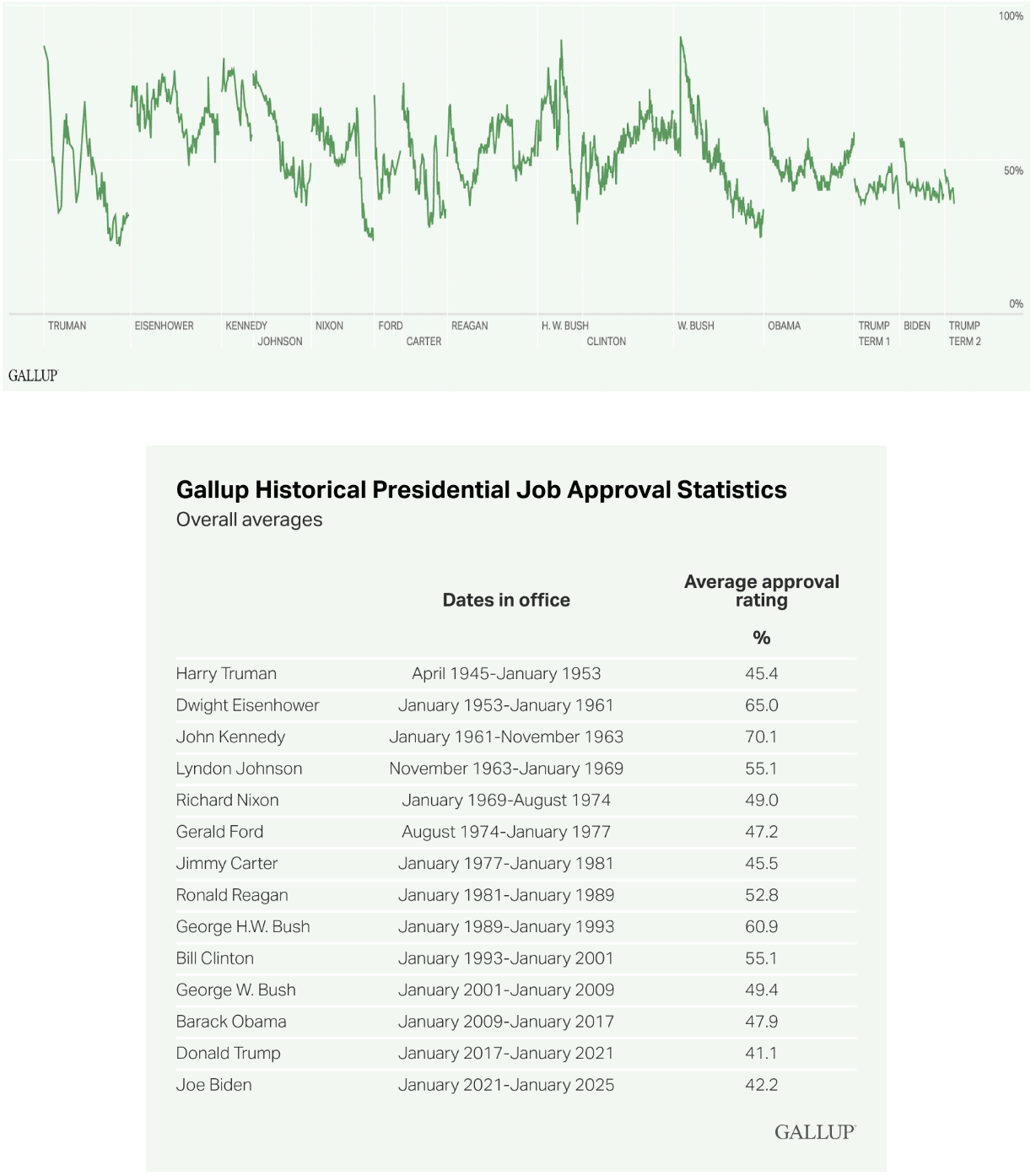
By The Numbers: 

  • On his 329th day in office, Trump’s approval was at 36%. This is roughly where his approval stood at this point in his first term, while his first term average was 41%. 
     

  • Presidents Harry Truman and Joe Biden received some of the lowest average approval ratings over the course of their terms, 45% and 42%, respectively.
     

  • Presidents Dwight Eisenhower and John F. Kennedy had some of the highest average approval ratings over the course of their terms, 65% and 70%, respectively.

The Bottom Line: Gallup has long been viewed as the gold standard of measuring approval rating, due to its long history and experience in tracking the sentiment. Moving forward, presidential administrations and political prognosticators will need to find new ways to compare public perception of sitting presidents to their predecessors. 

Related PollingNews

Placeholder polling news
June 11, 2026 |
Polling News
As the country prepares to celebrate on July 4th the 250th anniversary of its founding, confidence in the American Dream is at an all-time low, according to a new AP-NORC poll. These numbers are largely driven by economic confidence, or lack thereof. ...
Placeholder polling news
June 04, 2026 |
Polling News
MTV reality-star Spencer Pratt set the internet ablaze with his creative AI videos that sparked conversations from Hollywood, CA to Huntsville, AL. ...
Placeholder polling news
May 28, 2026 |
Polling News
Democrats have led on the Generic Ballot for the last few months. This isn’t surprising, given that history generally favors the party out-of-power in a Midterm Election. ...
Placeholder polling news
May 21, 2026 |
Polling News
The electorate has shifted over the last ten years, in large part because of the changing allegiances of white non-college-educated working-class voters. ...
Button karlsbooks
Button readinglist
Button nextapperance