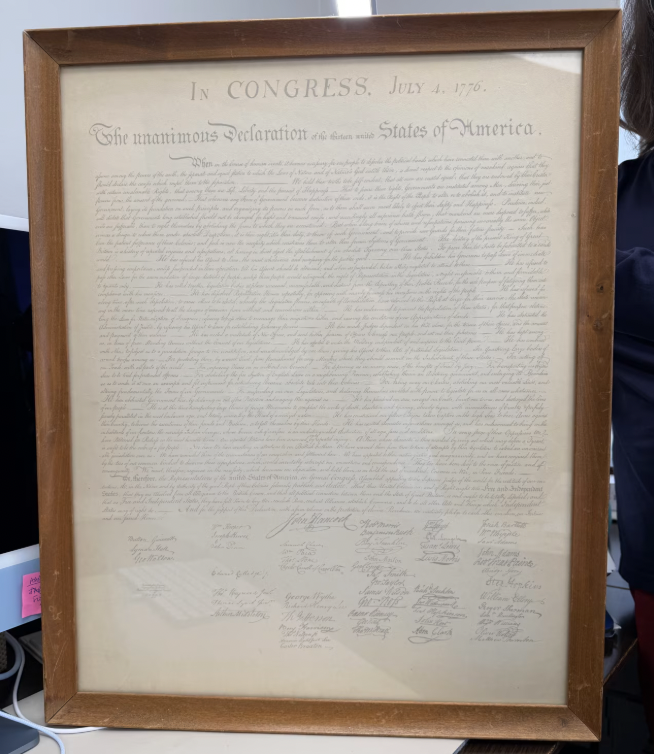
It hangs where I see it every day I’m home. The years have taken their toll. The paper has turned brown, the words have faded. It’s one of the last remnants of my childhood, a gift from my taciturn Norwegian father.
He sometimes read the Declaration aloud on Independence Day. I was especially taken by the sentence that begins “We hold these truths to be self-evident.” Those truths still hold and should still stir every American.
The historian Gordon Wood put it well. The Revolution that the Declaration announced “radically and thoroughly transformed” American society. It “destroyed aristocracy,” made “the interests and prosperity of ordinary people . . . the goal of society and government,” and released “powerful popular entrepreneurial and commercial energies.”
America wasn’t built by the rich and powerful but in large part by discards, rejects, losers and throwaways who made their way here. “Give me your tired, your poor, / Your huddled masses yearning to breathe free, / The wretched refuse of your teeming shore” Emma Lazarus wrote in her 1883 sonnet, later inscribed on the Statue of Liberty’s pedestal.
Inspired by the Declaration, people have come over the centuries hoping life could be better. Abide by its principles and the Constitution written to secure them, the promise went, and you and America can flourish.
We have. What began as pioneers huddled on a narrow coastal strip, an ocean away from the civilization they knew and facing an immense, unknown land is now a mighty nation that spans a continent.
America has become the most prosperous, compassionate, innovative, open society the world has known. Despite our challenges, doubts and divisions, America still demonstrates every day what a free people can achieve—for their families and the nation—if we strive to make the Declaration’s words real.
Who wants to leave home for the nations that reject outright the principles of our founding documents? Instead, many still want to come here.
I was once in Abuja, Nigeria, and a cabdriver asked where I was from. Like all Lone Star chauvinists, I said Texas. He replied, “Ah, America. I want the American Dream.” I asked what he meant. “Dream big, work hard and rise.” He sounded like Abraham Lincoln, who according to the historian Gabor Boritt believed in the “right to rise.”
Creating America wasn’t easy, and the fulfillment of our founding documents still demands much. But we make a grave mistake if we think this nation is only for what some call “heritage Americans,” whose forebears—specifically Anglo and Scots-Irish Protestants—fought in the Revolution or Civil War.
This notion that there is a select subset of “real” Americans is being pushed by, among others, Vice President JD Vance. He says that “America is not just an idea” but “a particular place, with a particular people.” Our country is more than an idea, but it began as one. Our people are particular, yet it makes no difference whether your forebear wintered at Valley Forge or fought at Gettysburg. What matters is living up to the Declaration’s promises.
It is ironic that Mr. Vance, a Catholic convert, would advocate “heritage Americans.” In the past, such movements routinely declared Catholics unacceptable members of our national family. One of the largest such groups was the American Protective Association, an anti-immigrant organization in the Gilded Age. It claimed 2.5 million adherents at its height. Its members swore an oath denouncing the pope and “the diabolical work of the Roman Catholic Church.” The APA was particularly strong in Mr. Vance’s home state of Ohio.
This notion of “heritage Americans” is at odds with the Declaration. America’s birth didn’t include a new aristocracy based on inherited valor.
Consider some Americans without Revolution or Civil War forebears: Elon Musk, Google CEO Sundar Pichai, Nvidia co-founder Jensen Huang, Arnold Schwarzenegger, Charlize Theron, Hakeem Olajuwon, former Pepsi CEO Indra Nooyi, Albert Einstein, Nikola Tesla, Salma Hayek, Henry Kissinger, Oracle’s Safra Catz, Bob Hope, Irving Berlin, Interactive Brokers’ founder Thomas Peterffy, Yo-Yo Ma, Alex Trebek and at least 40 winners of the Nobel Prize for Medicine.