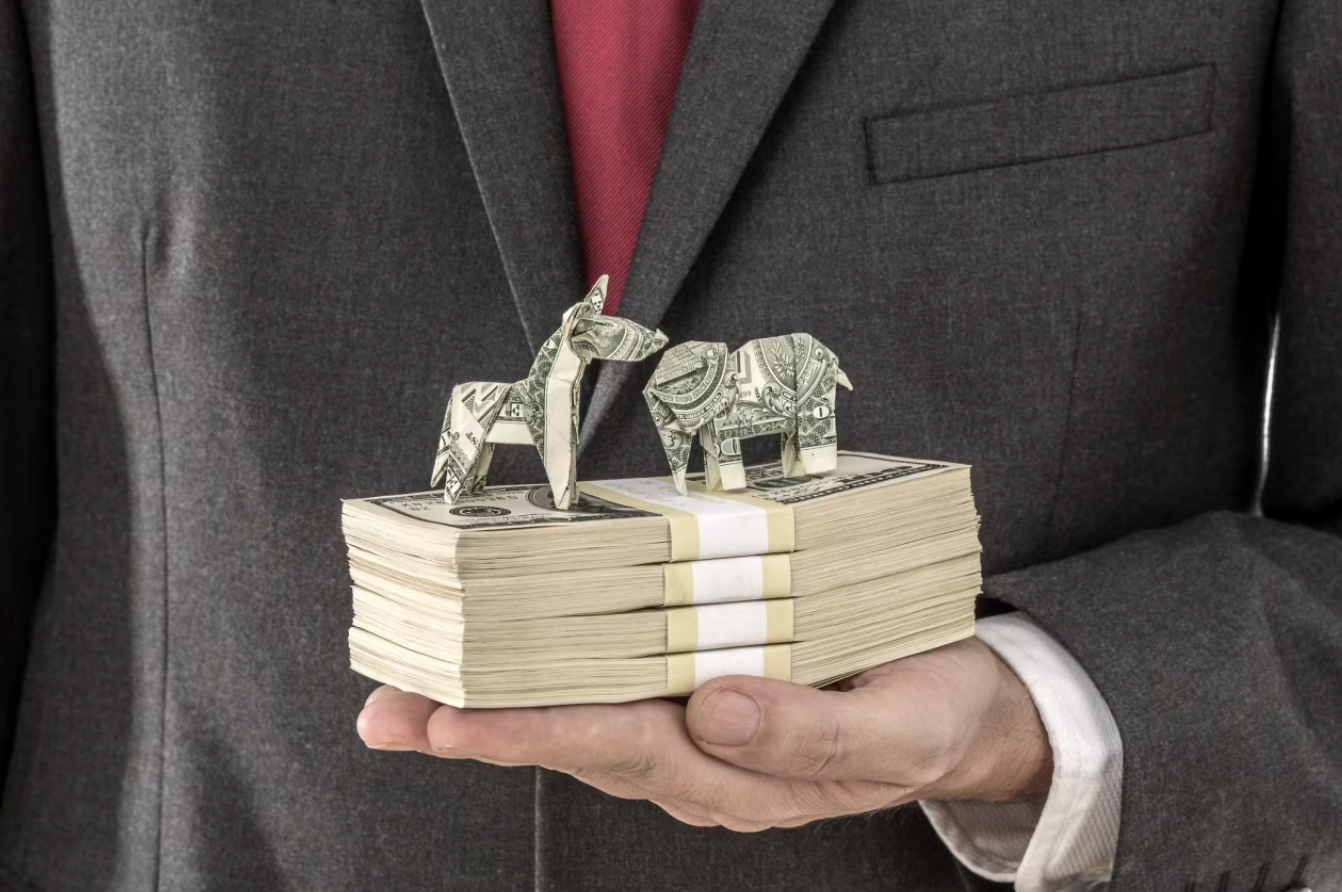
As we approach Labor Day—unofficial start of the general-election season—campaigns are obsessed with money. In these final months, good campaigns worry over whether there’s enough cash to run ads, deploy organizers, unleash digital efforts, pay staff and keep the candidate on the move. This time around, which party will have the financial lead this fall is a big question.
At a candidate level, Democrats have the hard-money edge in both Senate and House races.
The most recent Federal Election Commission reports on the nine most competitive Senate races show Democrats outraising Republicans in seven and with more cash on hand in five. Of these races—Alaska, Georgia, Iowa, Maine, Michigan, New Hampshire, North Carolina, Ohio and Texas—Democrats must win seven to take the Senate. Excluding Maine, where Democrat Troy Jackson replaced Graham Platner as a Senate candidate less than two weeks ago and has yet to report his fundraising, Senate Democrats told the FEC they’ve raised $290 million, while Republicans have brought in $196.8 million. More important, Democrats have $117.3 million cash on hand to the Republicans’ $85.3 million.
The GOP can claim some sort of fundraising advantage in only four Senate races. Republican candidates in Iowa and Maine appear ahead both in total fundraising and cash on hand. Maine’s Mr. Jackson has said he received $2 million within three days of his selection and had raised $1 million before the convention that picked him. Republican Senate candidates in Alaska and Michigan were outraised overall but have more cash on hand.
In the five other battlegrounds, Democrats raised more money and have more cash on hand. The problem for Republicans is acute in Texas and Georgia. In the Lone Star State, the Democrat raised $68.6 million with $21.6 million cash on hand, while the Republican raised $9.2 million and has $1.8 million in the bank. The Peach State’s Democrat raked in $98 million and holds $42.6 million; the Republican collected $7.4 million and retains $2.1 million.
In the House, Republicans are in slightly better shape. In the 18 House races the Cook Political Report considers toss-ups, 10 Republicans outraised their opponents. Each party has an equal number of races—nine—in which it has more cash on hand. In total, Republican House candidates in these contests have collected $86.7 million while retaining $51 million, Democrats $82 million with $41.6 million in cash. (This includes the money of each party’s leading candidates in Florida and Wisconsin, where primaries are coming.)
But Democrats can’t rest easy—in super PAC, committee, national party organization and large outside group money, the GOP has big advantages. The seven largest Republican PACs and party committees have about $1.17 billion cash on hand. The eight biggest Democratic ones have roughly $494.2 million.
While candidates can buy television much more cheaply than PACs and party committees under Federal Communications Commission regulations, GOP groups’ mountain of money could more than wipe out whatever candidate-money advantage Democrats have.
But maybe not, because $461.5 million of the GOP’s advantage sits in the MAGA Inc. and Never Surrender PACs. Both are controlled by Trump world, and the president may decide he prefers to keep the cash for his presidential library.
The GOP House and Senate super PACs said earlier this year where they’ll spend their dollars. They were signaling the White House political shop where its help was needed. Trump money is needed in the Texas and Georgia Senate races, where the president’s endorsement decided the primary and his picks are lousy fundraisers. There are also dozens of House seats considered “lean” or “likely” Republican seats that need financial support.
If President Trump deploys those dollars, it will matter if he does so directly or through Republican super PACs. The former would mean “MAGA Inc.” and “Never Surrender” disclaimers on the ads, which would bring harsh attacks from Democrats. The president’s low approval rating already hurts GOP candidates a lot, so why not lower his profile in ad campaigns?