
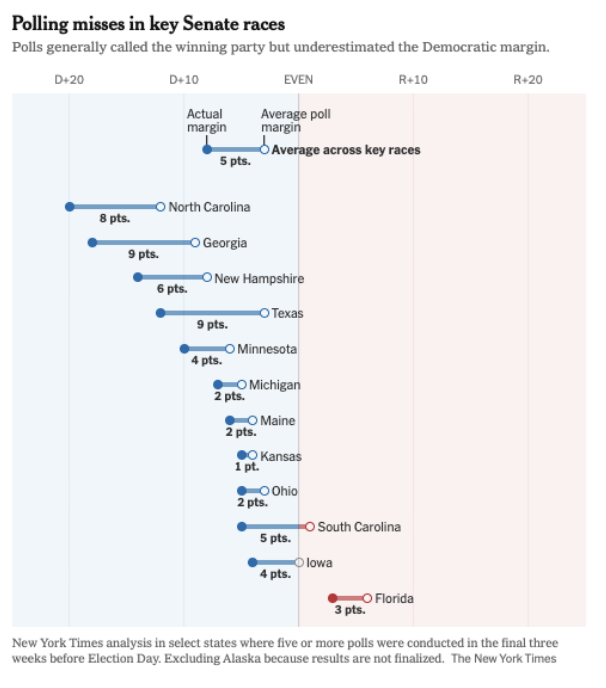
2026 was always going to be a difficult year for Republicans, given the historical tendency for the party-in-power to lose ground in midterm elections. In the lead-up to November, much of the debate centered on whether polls were once again underestimating Trump and rural Republican voters. But the polling error appears to have gone in the opposite direction: polls underestimated Democratic support, according to a New York Times analysis.
By The Numbers:
National polls throughout the year underestimated Democratic support by roughly four percentage points. The polling error was even larger in key Senate races, where polls understated Democrats’ position by five points, compared with an average miss of approximately 3.5 points across all Senate races.
The average polling miss was the biggest in Texas (9 points), Georgia (9 points), North Carolina (8 points), New Hampshire (6 points), South Carolina (5 points), Iowa (4 points), Minnesota (4 points), Florida (3 points), Michigan (2 points), Maine (2 points), Ohio (2 points), and Kansas (1 points).
The Bottom Line: Some argued that low response rates in rural Republican areas, particularly in Iowa and Kansas, suggested that so-called “quiet Trump voters” could defy expectations on Election Day. However, the lack of engagement may have been an early warning sign that these core voters were less likely to turn out. While polls should always be viewed as a snapshot in time rather than a definitive prediction, early trends are worth monitoring. Identifying these signals early allows campaigns to reassess their assumptions and adjust their strategies accordingly.


